Posts

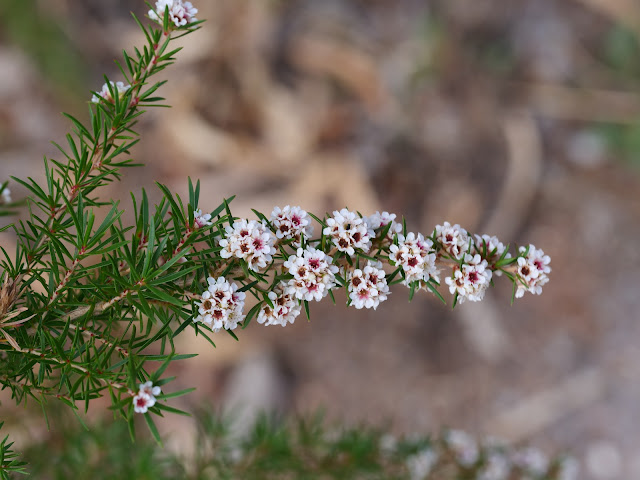
Taxandria juniperina
Image
Juniperina meaning Juniper like. Occurs from Forest Grove and Scott River east to the Kalgan River and Waychinicup. Grows on the margins of winter-wet or permanent swamps or watercourses, sometimes forming dense thickets. Tree or upright shrub to 27 m tall. Note though that very small young plants flower. Leaves typically linear, flat or concave above and convex below, 7–13 mm long, 0.3–1.5 mm wide, hairless apart form some appresed marginal hairs, tip pointed with a very short mucro (exposed tip to vein). The leaves are 'soft' to the touch, very unlike the coarse, rigid leaves of Taxandria fragrans which may occur nearby. Flowers in globular clusters 6-8 mm across on short axillary shoots, bracts and bracteoles may be hairless or somewhat hairy, sepals hairless and with a pointed tip. Petals white. Stamens 10, one opposite each sepal and petal. Fruits in roughly globular clusters, typically 8–10 mm across. Each capsule roughly cup-shaped 2.5–3 mm across hairless or downy. Flow...

Taxandria linearifolia

Image
Linearfolia from the Latin linearis - linear and folius - leaved. Occurs from about 80 km north of Perth (Gingin and Wongan Hills) to the extreme south west of the state and east to the Stirling Range and Mt Manypeaks. Grows bordering swamps and watercourses, on loam, clay or sandy soils in forest, woodland or shrubland. A shrub or small tree to 5 m high, sometimes weeping. Leaves usually single, sometimes clustered on short axillary shoots, well-spaced and usually spreading (less so on weeping branches), very shortly stalked; blade narrowly elliptic, more or less flat, 7–45 mm long, 0.5–4 mm wide, normally largely hairless, midrib and also sometimes 2 more very faint longitudinal veins evident on lower surface, base tapered, sometimes with sparse appressed marginal hairs, tip normally pointed with a short mucro (exposed section of leave vein) or less often rounded. Flower clusters axillary or terminating short axillary shoots, 5–9 mm across. Bracts and bracteoles hairy. Sepals wooly ha...

Taxandria marginata

Image
Marginata from the Latin, furnished with a border. Refers to the hairy leaf margins. Occurs in disjunct populations from Chatham Island and the Woolbale Hills west of Walpole along the coast to Cheyne Beach and also between Esperance and Cape Arid and the islands of the Recherche Archipelago. Grows in association with granitic outcrops or boulders in coastal or near-coastal heath or woodland. A shrub to 3 m tall. The leaves single not clustered, generally broadly elliptic, more or less flat, 9–28 mm long and 4–10 mm wide with a stalk 1-5 mm long, with 3–5 longitudinal veins, somewhat hairy or hairless but with a band of appressed fine hairs around the margin. Flower clusters axillary or terminating short axillary shoots, 10–12 mm across. Bracts and bracteoles hairy. Sepals densely hairy with a rounded triangular tip. Petals white. Stamens 10, one opposite each sepal and petal. Fruits in roughly globular clusters, typically 7–15 mm across. Each capsule roughly cup-shaped 2.5–3.5 mm acro...

Taxandria parviceps

Image
Parviceps from the Latin parvi - small and ceps - headed. Refers to the small flower heads. Occurs from near Dardanup throughout the extreme south west of the state as far east as Two Peoples Bay; also recorded north to the Porongurup and Stirling Ranges. Grows in heath, shrubland, woodland or forest, often on the margins of seasonally wet areas, mostly on sandy soils and often forming quite dense thickets. In the Stirling Range the species has been recorded on heavier soils at rocky sites. A shrub or very small tree to 4 m tall. The leaves usually clustered in short axillary shoots, stalkless, spreading, curved outward in upper half, narrowly obovate or narrowly elliptic, occasionally some leaves obovate to elliptic, thick, the upper surface flat to slightly concave, the lower surface slightly convex, typically 3–7 mm long, 0.6–1.5 mm wide, hairless but sometimes with minute hairs at the leaf base, tip rounded or pointed often with a minute point. The flowers are in more or less globul...

Taxandria spathulata

Image
(c) David McCorquodale, some rights reserved (CC BY) Spathulata from the Latin - spoon shaped. Refers to the shape of the leaves. Occurs from the Stirling Range and Porongurups east to Israelite Bay, extending north to near Lake King. Grows in a variety of habitats, most commonly on sandy soils in heath, shrubland, malleeheath or woodland. Shrub to 2 m tall. The leaves single not clustered, spathulate; stalk usually 0.5–1.5 mm long, shortly hairy; blade elliptic or almost circular, flat to very slightly concave above and convex below, often somewhat recurved, 2–6 mm long and 1.5–5 mm wide, largely hairless.  Flower clusters terminal or terminating short shoots, hemispherical to globular, 8–10 mm across. Bracts largely hairless, bracteoles densely hairy down keel. Sepals with sparse coarse hairs particularly towards the tip, which may be triangular or rounded. Petals white. Stamens 10, one opposite each sepal and petal. Fruits are in globular clusters, typically 7–8 mm across, the sh...